
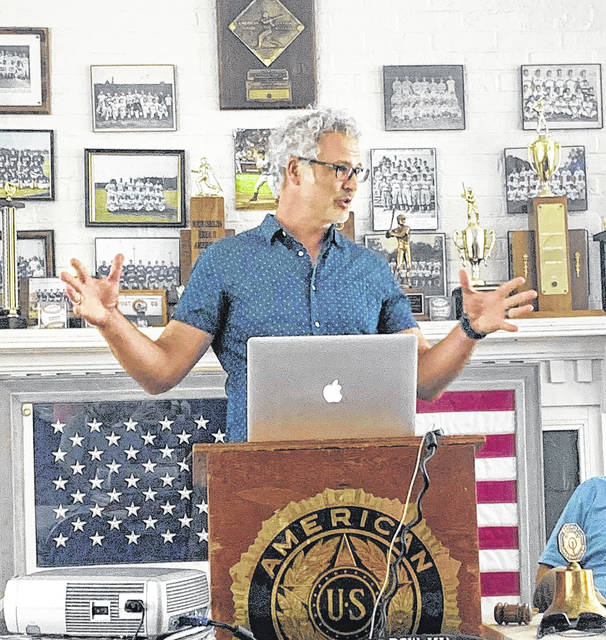
LAURINBURG — A 1992 Scotland High School graduate came back to Laurinburg on Thursday to speak to the Optimist Club about archaeology and an overseas project he’s been working on.
Chris Witmore is currently a professor at Texas Tech University for archaeology. He has worked in Greece for 25 years, as well as northern Iceland and Norway.
Whitmore focused on the project in the far north of Norway, which he has been working since 2011. The site was a part of the German Atlantic Wall during World War II, built by prisoners of war, and is located in Svaerholt sitting 300-plus miles north of the Arctic Circle.
“We’re there because we want to take a period saturated by history and show you what archaeology can do that’s different,” Witmore said. “It’s what you might think — it’s sleeping on the same soil and ground these POW’s did and these soldiers did, it’s drinking from the same streams, it’s digging into the same earth, it’s learning where they went to the latrine, it’s learning about their daily interactions with this place.”
Witmore said that it helps bring the stories to life in a way history cannot, since the archaeologists are there living in the same place with the same conditions.
He added that WWII changed all of Norway’s infrastructure, with roads and airways being built — so after the war much of the country turned from the sea with small villages to the land with larger towns being built.
Witmore shared photos of what remains of the camp and shared that, despite the war ending in the area in November of 1944, in archaeological terms, the area is still coping with the result of this battery. The current issue has reindeer getting caught in barbed wire, still have landmines and more issues.
“You think you know what you see on the surface,” Witmore said. “But when you go into the soil it’s a whole different world. You find all kinds of things that you wouldn’t believe are there because the soil grabs it and holds it.”
Witmore added that, at the camp, despite history showing a divide between POWs and soldiers, they developed a rapport and relied on each other.
“As an archaeologist, sooner or later you figure out what you do is very different than history,” Witmore said. “History studies the past and what was, archaeology studies what becomes of that. Where history focuses on big events and people archaeology is for the rest of us.”
Reach Katelin Gandee at 910-506-3171 or at [email protected]

Leave a Reply