

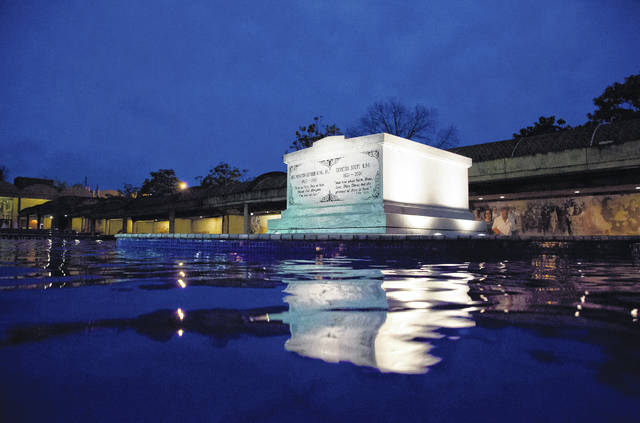
LAURINBURG — Scotland County leaders took time to reflect on the life and loss of Martin Luther King Jr. on the 50th anniversary of his assassination.
King, a Baptist minister, founder of the Southern Christian Leadership Conference, and Civil Rights icon, was assassinated in Memphis on April 4, 1968.
County Commissioner John Alford said the country has improved in terms of equality, but still has a way to go.
“In many ways things are better. Race relations are better,” Alford said. “We’ve made strides in education. As relates to public accommodations things are much better, but we are beginning to deteriorate because leadership we have in Washington has brought out the worst in all of us instead of building on the best.”
Sheriff Ralph Kersey remembers watching King’s work as a young man but not fully understanding what King was trying to accomplish. In the years since, he has studied King’s life and developed a deep admiration and respect for his legacy.
“I believe that we have come a long way from what Martin Luther King was protesting about, and some of us are still trying to do everything he was trying to accomplish. We now live in a society where we all socialize and go to church and worship together,” said Kersey. “I wish we had more like him today. He spoke a message that involved everyone throughout America. His message was true because he spoke for people of all races.”
Kersey believes lingering racism is a matter of the heart and only when the heart changes will social justice follow.
“There are still some that have issues with racism and will continue to have it. The only thing that will take that problem completely away is that we turn back to God. That not only applies to racism but it applies to all the issues we have violence, gangs all of it,” he said.
Alford believes that to change things work must be done at the grassroots level much like King’s efforts. Only by changing ourselves and our communities first will we be able to change things on a larger scale.
“You can’t expect race relations and morality to begin in the Whitehouse. It begins in our community, homes, churches, city organizations and local leadership. And we need to expect moral leadership not just in our president but in all three branches of government,” he said. “We need to set a better tone. We’re all in this together, all races, nobody can point fingers.”
Alford believes that King’s legacy and its continued effort is so strong because the leader was “divinely sent by God.” He believes that King’s spirit and presence are still strong and that spirit is what keeps people striving for equality. Alford believes that the best way to build on King’s work and honor that spirit is to connect with others.
“We need to reach out the each other, not look down on each other and build on our strengths and not focus on the negative,” he said.
Dorothy Tyson of gospel station WEWO shared the following thought on continuing King’s work.
“Dr. King spoke of the ‘other America,’ it existed then and continues to exist today. We must protect the rights of all Americans regardless of race, creed, gender, religion, sexual orientation, etc. The dreamer was assassinated, but the dream is still alive,” Tyson said.
King’s life and death
King remains the most recognizable leader of the civil rights movement since it began in earnest in the mid-1950s. He was known for impassioned speeches and nonviolent protests to make a peaceful but forceful stand against segregation and bring about civil-rights and equality for African Americans and all people of color.
In his later years King took a stance on other soci-economic issues that were connected to Civil Rights such as poverty and housing. He had also spoken against the Vietnam War.
King was in Memphis to support a strike among sanitation workers who were largely African American. He and other SCLC members were also preparing a march to Washington to lobby Congress on behalf of the poor or all races.
On the evening of April 3, King gave a speech at the Mason Temple Church in Memphis. Given what occurred the next day, the words he ended his speech with are eerily prophetic, “I’ve seen the promised land. I may not get there with you. But I want you to know tonight, that we, as a people, will get to the Promised Land. And I’m happy tonight. I’m not worried about anything. I’m not fearing any man. Mine eyes have seen the glory of the coming of the Lord.”
Shortly after 6 p.m. the next day, King killed while standing on the second-floor balcony of the Lorraine Motel. He was struck by a bullet in neck; he was rushed to a hospital and pronounced dead an hour later. He was only 39 years-old.
To honor King’s work, President Lyndon B. Johnson urged Congress to pass the civil rights legislation which was being taken up for debate by the House of Representatives. On April 11, Johnson signed the Fair Housing Act.
Two months later law enforcement arrested James Earl Ray, who was suspected of the assassination, at Heathrow Airport in London.
Witnesses testified that Ray had been seen running from a boarding house near the Lorraine Motel carrying a bundle. Prosecutors said that Ray fired from a bathroom in that building. Investigators also found Ray’s fingerprints on the rifle used in the murder, a scope and a pair of binoculars.
Ray pleaded guilty to murder in March 1969 and was sentenced to 99 years in prison. Ray later recanted his confession and claimed that he was the victim of a conspiracy.
