
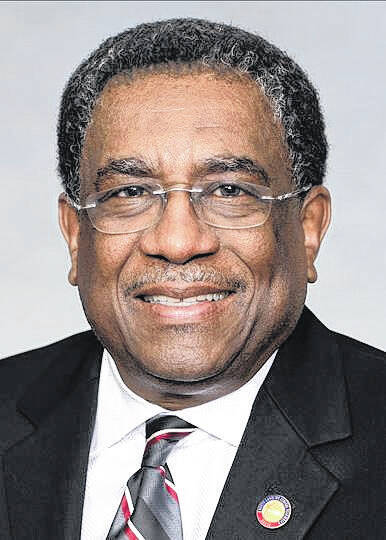
RALEIGH — Rep. Garland Pierce says he has attended too many funerals in Scotland County.
Four teenagers in his district died from gun violence during the 2024-2025 school year. More disturbing for the pastor is the apparent sense of resignation.
“The young people, I don’t want to say they get immune to it,” Pierce told NC Insider/State Affairs. “The church is jam packed with young people who realize there’s no coming back. Their worlds are shattered. There’s hopelessness on their face. Their wondering in their mind, ‘Who’s next?’”
The 72-year-old pastor at Bright Hopewell Missionary Baptist Church said schoolyard taunts that used to end in fistfights in his day now end with bullets.
“These young people, they arm themselves for the threats of ‘I’m going to get you, I’m going to kill you,’” he said. “The thing about the threats now is they follow through. That’s the difference. So what are you going to do? What ends up happening is the mentality of ‘Tried by 12 or carried by six.’ It’s your choice. It’s unreal.”
Eurekus Pate, president and founder of Youth Against Gun Violence of Scotland County, was inspired to form a mentoring community following the loss of his wife to gun violence in 2009. Over the last 17 years, Pate said firearm violence has gotten worse in his community of nearly 34,000 residents.
“It’s a choice that those young adults are choosing to carry those guns,” Pate said. “We can only teach when they’re in our presence – but a split second decision can change everything.”
The problem has surfaced in concrete ways recently. In March, a gun was found inside a student’s car at Scotland High School. A magazine to the firearm was found on the student during a routine entry check. In a separate incident, a 13-year-old was shot in a drive-by in the early morning on Blakley Road a few weeks later.
“That’s the answer to young people who are involved in that type of gun violence. They just want to bring an end to it,” Pierce said. “That’s the mentality in their heads.”
As the Legislature gets through the short session, one area of immediate concern for Pierce is the House’s pending override of Senate Bill 50, the Freedom to Carry Act, which allows anyone 18 and older to carry concealed handguns without a permit or training.
“Grandmama used to always say, ‘If you carry a gun, someone will make you use it,’” said
Pierce, the only Democrat in the House representing any county between Charlotte and Wilmington.
Spike in firearm homicides
North Carolina experienced a statewide wave of firearm homicide beginning in 2019 that peaked in 2021 and has steadily declined, according to a Criminal Justice Analysis Center report released last month.
But between 2020 and 2024, rural areas with populations between 10,000 and 50,000 had the highest rate of firearm homicide. A trio of rural counties in the eastern half of the state — Hertford, Robeson and Scotland — had higher rates of firearm violence per capita than any urban county.
While Charlotte and Greensboro account for the largest raw counts of firearm violence, their per-capita rates were significantly lower than those of the three rural counties. Major urban counties recorded less than 12 firearm homicides per 100,000 residents, while the three highest rural counties had homicide rate ratios of over 25.
This phenomenon is not a new occurrence, according to Rose Werth, a program analyst for the Criminal Justice Analysis Center, who provided an overview of the data to the Gov. Crime Commission in March.
“This pattern has appeared at various points over the last 30 years, depending on whether you look at raw counts (total firearm deaths ) or rates (deaths per 100,000 people, which accounts for population differences and allows for meaningful comparisons across areas of different sizes),” she said in a statement to NC Insider. “What stands out is the recent spike: rural counties experienced the sharpest increase in firearm homicide during the early years of the COVID-19 pandemic.”
The report found that youth ages 20-24 face the highest rates of firearm violence along with an elevated risk for suicide via firearm. A majority, 51%, of firearm homicides take place in the home, and 54% involve a handgun.
A cluster of northeast counties alongside the Virginia border have experienced some of the highest rates of firearm violence. That hotbed is concentrated across the districts of Rep. Bill Ward, R-Pasquotank, a former patrol commander with his local Sheriff’s Office.
“This is just destroying families and the youth population,” Ward told NC Insider. “It’s exasperating. Back in the day, we settled our disputes on the schoolyard with fists. Now, it’s gotten to ‘Don’t disrespect me or I’m going to put a cap in you.’”
There have been four shootings involving youth in his small town so far this year, Ward said. Some initiatives to stem the increase in youth violence have been launched, but it’s not enough to address the root causes, Ward said.
More parent involvement is imperative, but there’s also a lack of attention on rural communities at the state level, Ward said.
The contrast with how the Legislature responded to high-profile urban violence isn’t lost on rural lawmakers. Following the fatal stabbing of Charlotte light rail passenger Iryna Zarutska in August, the General Assembly grilled Charlotte and Mecklenburg leaders on the state of crime and public safety during lengthy Oversight hearings. The Legislature subsequently passed Iryna’s Law in September, which toughened pretrial release conditions for violent offenders. Gov. Josh Stein signed it into law in October.
During his February address to Congress, President Donald Trump referenced Charlotte about a second high-profile stabbing incident that took place in December. “By the way — What’s going on with Charlotte,” he said before the nation.
“[The General Assembly is] more focused on [those two Charlotte incidents] than they are in the rural counties,” Ward said. “They look at these high-profile incidents and don’t quite focus on the rural communities that are seeing it.”
‘Neglected Northeast’
Rep. Rodney Pierce’s district overlaps with some of the most violence-plagued communities in North Carolina. The Democrat calls his corner of the state the “Neglected Northeast.”
“Everybody sees it man, but nobody wants to do anything about it,” he said. “We are just supposed to die.”
Pierce, no relation to Garland Pierce, worries that the high-profile incidents in Charlotte overshadow the rural communities who are experiencing more violence.
“Mecklenburg is overwhelmingly blue,” he said. “… The majority party doesn’t want to necessarily highlight issues of violent crimes in their jurisdictions. It might lead to more credence [to the fact that] we might need a little more help.”
As a high school teacher, Pierce has seen firsthand how his students respond to growing up with violence.
“[Violence] doesn’t even faze them unless it’s someone that’s close to them,” he said. “We run the risk of desensitizing our children to violence when they accept it and don’t think it’s something that needs to be stopped.”
That flight is already happening – Carolina Demography found that Halifax County had the highest percentage of declining population last year, losing 1% of its population.
“Rural lives matter,” Pierce said. “That’s what happens when you live in a rural area and people don’t deem that as safe. They’re not going to want to move and live there.”
Violence prevention town halls
Over the past year, a series of youth violence prevention town halls have been convened across the state — including in Scotland, Hoke, Halifax, Northampton and Wayne counties — to bring together local community leaders, law enforcement and state officials.
Nearly 100 people attended an event in Scotland County in response to the four high schoolers who died due to gun violence. Creating a sense of safety is a part of the dialogue at these events. A Center for Safer Schools survey found the primary reason young people carry a gun is not to show off but to protect themselves.
“How do we address the root cause of that problem — That that kid feels unsafe in their school and their community?” said Billy Lassiter, director of juvenile justice for the Department of Public Safety.
Lassiter attributed part of the surge to a pandemic-era spike in firearm purchases among buyers who weren’t necessarily educated in responsible gun ownership. In 2000, only 4% of juvenile crime involved a firearm, Lassiter said. Now, it’s 14% of all juvenile crime.
“When a kid carries a firearm in the commission of a crime or just carries a gun to school, it ups the repercussions for that child and the community,” he said. “[Older adults who coerce young people] tell them they won’t face as large a consequence because they’re juveniles.”
“We’re educating people that if you commit a crime with a gun, you will face severe consequences,” Lassiter said of his presentations at town halls, adding that about 10 more are planned for this year.
Other Department of Public Safety initiatives include funding for campaigns on gun safety and education programs at middle schools on the perils of gun violence.
Rep. Garland Pierce is encouraged by the town hall efforts but said those most in need of the outreach are most likely to be out on the streets.
A similar town hall in 2021 in neighboring Rockingham had a lot of community input following a double-murder committed by a 17-year-old, but talk doesn’t always translate into immediate action. Community members stated at the time that while there was a lot of bluster from local officials, no youths were in attendance.
“We’re reactive, but we’re not pro-active,” Pierce said. “You brought the resources, told them what to do, but it’s going to take the whole community. We got to really believe that. We’ve got to be totally concerned about the whole community and I think sometimes we drop the ball on that.”
Rural Violent Crime Task Force
Following the passage of Iryna’s Law, over 60 legislators signed a letter asking the governor, Senate Leader Phil Berger and House Speaker Destin Hall to create a Rural Violent Crime Task Force to propose region-specific solutions for rural communities experiencing violent crime.
Democrats primarily signed on in support of the measure, but the letter also gathered signatures from Republican Reps. Bill Ward and Cody Huneycutt, as well as former Reps. Jarrod Lowery and Mike Clampitt.
The task force would seek to expand community violence prevention grants for small towns and sustain funding for local school resource officers and rural re-entry councils.
Sen. Norman Sanderson, R-Pamlico, was the lone lawmaker from his chamber to throw in his support. His northeastern district partly matches up with those represented by Reps. Rodney Pierce and Bill Ward.
When he receives newspapers from across his district, Sanderson said just about every copy includes a mention of a homicide. He said he understands why places such as Halifax County are in the top tier of rural firearm violence rates and steadily lose population. It’s an issue he said he plans to raise to leadership.
“We bring our own thoughts to the General Assembly, but we don’t know all of the facts of what’s going on,” Sanderson, a member of the Justice and Public Safety Committee, said. “I don’t think there’s anybody who has a total solution. We need to hear from those who are directly dealing with this problem, instead of us just bringing what we think should be done …. It’s something we need to look at in the long session.”
Spokespersons for the legislative leaders said they didn’t have an update on the task force. In March, Stein and his agencies started a rural listening tour that covers public safety initiatives.
The Department of Adult Correction and the Department of Public Safety are launching a Public Safety Tour with stops that will convene local law enforcement to hear what their communities need to be safer and stronger. The first roundtable will be held in Wilson County on Wednesday, May 27.
For questions or comments, or to pass along story ideas, please write to Matthew Sasser at [email protected] or contact the NC Insider at [email protected] or @StateAffairsNC
Leave a Reply