

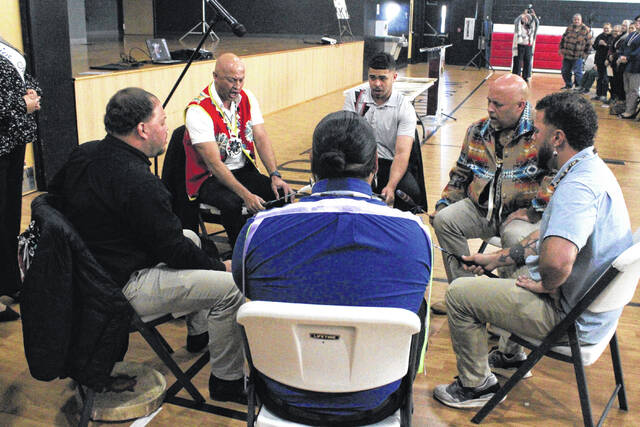
Lumbee Tribal Chairman John Lowery, second from right, and the Dark Water Society play an honor song at a ceremony recognizing the anniversary of the Battle of Hayes Pond Friday in Pembroke.
Chris Stiles | The Robesonian
PEMBROKE — The Lumbee Tribe gained full federal recognition on Dec. 18, when President Donald Trump signed into law the National Defense Authorization Act, which included the Lumbee Fairness Act.
After accomplishing that longstanding goal, the Tribe will now enter a period of transition over the next months of years — a period which has already begun.
“We’ve created an internal transition team that’s working with the (Bureau of Indian Affairs’) team that has been tasked to work with us. We’re working with them, we’re providing them with documents and stuff now,” Tribal Chairman John Lowery said. “So there’s just a lot coming, and I know that our people want to know what’s next. The thing is, I’m asking people to be patient about it, because we’re learning. I’m committed to putting out a weekly video about things that are coming down the pipe.”
The “services and benefits” which were denied to the Lumbee by the Lumbee Act of 1956, which granted only partial recognition, and are now available after the Lumbee Fairness Act’s passage, are numerous and span a wide variety of areas.
The Tribe is in a good position organizationally to take on the added influx of services, Lowery says, with nearly 200 employees, far more than some other recently recognized tribes had at the time of their recognition.
Health care
Lowery has stated multiple times since Dec. 18 that he believes the biggest benefit to the Lumbee people will be health-care resources, including the ability to enroll in Indian Health Services.
“Health care is one of those things that I want us to take our time, and I want us to be strategic about it, because we do have an opportunity to do a lot there, but at the same time, we need to have the infrastructure in place, have the people in place to be able to provide different health care services,” Lowery said. “I am interested in partnering with others that are already in the health care arena, which would probably ease the burden on us as a tribe trying to do some things.”
As part of its negotiations with the BIA prior to receiving full federal recognition on what that transition may look like, the Lumbee agreed to a three-year delay for its members to become eligible for benefits. However, it is normally a process of approximately three years anyway, so that provision will essentially cause no further delay to the Lumbee Tribe.
“That period will give us time to get our infrastructure in place and to be able to be ready to provide those services when the time comes,” Lowery said.
Agriculture
The Lumbee Tribe created a Department of Agriculture and Natural Resources in 2022, Lowery’s first year as chairman. It now hopes to find funding to help further develop that department, including U.S. Department of Agriculture funds which are set aside strictly for fully federally recognized tribes.
“We’ve never had access to that money,” Lowery said. “And so now I told my team, look, we have priorities for the Agriculture and Natural Resources Department, things we’ve been doing, and now let’s go look at the federal USDA and let’s go and start identifying those programs that align with what we’re currently doing and our current initiative, and let’s go get funding.”
Lowery also said he would like to create a Lumbee food brand, with product from local farmers, which could go into restaurants and markets, or even to schools, military sites or prisons. This idea correlates to the establishment of the Lumbee Tribe’s Food Processing Center, which opened in November.
Casino?
Due to their status as sovereign nations, Indian tribes are allowed to open casinos on territorial land, such as the Harrah’s Cherokee Casino, owned by the Eastern Band of Cherokee Indians in western North Carolina. Whether or not a casino could be in the Lumbee Tribe’s future has been the subject of much speculation in and around Robeson County, even before federal recognition passed.
Lowery says that the Tribal Constitution would require a vote by the tribal membership on such an ordinance. That vote could happen as soon as the next 12 months, he said, to establish whether or not a casino would have a path forward.
“If the people do decide to do a casino, we will look at that; if the people decide not to, then we won’t,” Lowery said. “That’s one thing that the authors of our constitution were very smart about was ensuring that the people have the right to vote on that, and not just me as a chairman or the Tribal Council or other boards coming together. … I think it would be very smart for us to have that vote sooner rather than later, just to go ahead and answer that question and see where the chips fall.”
Land in trust
While the Tribe currently owns the land that some of its notable landmarks sit on, such as the Lumbee Tribe Housing Complex (also called the Turtle), the Pembroke Boys & Girls Club and the Lumbee Tribe Cultural Center, among others, the Tribe will now have the opportunity to put that land into trust.
This means that the federal government will protect that land, and the Tribe will retain ownership in perpetuity.
The Tribe is also eligible to put land into trust for economic development. Lowery’s idea is to create a business park with land in trust, particularly since Interstates 74 and 95 each dissect tribal territory. That park could potentially offer space to businesses with significant tax benefits, while creating jobs for the community which increase the tax base through personal income, he said. He also likes the idea of an inland port.
Historic preservation
When various American Indian artifacts have been found in non-territorial areas, the government consults with federally recognized tribes to determine who it may belong to or if it is culturally relevant to a tribe. The Lumbee has generally not been in these conversations and consultations prior to receiving full federal recognition; Lowery says that the Tribe is already seeing a difference here, just one month removed from the Lumbee Fairness Act’s passage.
As an example, Lowery said cited a past situation with artifacts found at Fort Bragg, and said that tribes as far away as Oklahoma were consulted but that the Lumbee, just miles away from the base, were not.
Programs through BIA
There are other programs and partnerships through the BIA which will now be available to the Lumbee following its recognition.
“There are some programs through the BIA that we want to be able to access in the future with regards to public safety, economic development,” Lowery said. “There’s programs through the Department of Energy that we’re very interested in. … The Department of Justice has a lot of programs, and I’ve already talked to the district attorney, Matt Scott, about potentially partnering on some of those grants and stuff, to help our youth, to help cut down on some of this youth violence.”
Other resources now available will include financial assistance, housing assistance, food assistance, health care and education, among other benefits.
In addition to educational resources available through the federal government, Lumbee youth will be eligible apply for scholarships for American Indian students which are only available to members of federally recognized tribes.
The Indian Child Welfare Act, which pertains to child custody and adoption of member children, also now applies to the Lumbee; Lowery said that the Tribe has already seen a difference regarding this since Dec. 18.
Other goals
After accomplishing a major goal that the Tribe has had since it first petitioned for federal recognition in 1888, Lowery said that its next goals will be to be strategic in figuring out what the next 10 to 20 years could look like for the Lumbee Tribe.
“Of course we do want to do a lot more with our youth, we see the opportunity to do more with our youth,” Lowery said. “We have an opportunity to help those who want to go to school. We have an opportunity, how can we do additional things for our veterans, how can we work with them around mental health. How can we work with our people about opioid addiction. I just think there’s a lot of avenues where the Tribe is going to play a significant role in years to come, and I just think we have to make sure that the programs and services that we go after now with our new status aligns with those issue areas.”
After the Lumbee has grown organizationally in recent years, even without much of the federal funding that it will now be eligible to receive, Lowery says “the sky is the limit” for the Tribe over the next 50 years and beyond. He hopes to see the Tribe “be a significant player” in southeastern North Carolina, and more broadly in the southeastern United States, and says that starts with solidifying the Lumbee’s relationships at the state and federal level as it undergoes its transition to full federal recognition.
Editor Chris Stiles can be reached at 910-416-5847 or by email at [email protected].