

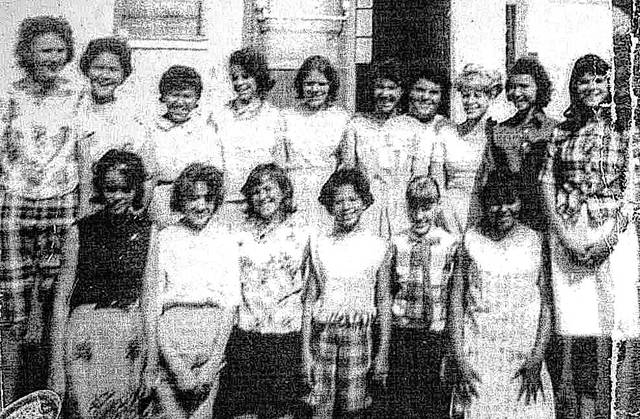
LAURINBURG — Oak Grove School might have played a small role in Scotland County’s history, and may be long forgotten in the minds of many, but it played a large role in the lives of those who are part of its past and present.
Oak Grove School (previously known as Oak Grove Indian School) was implemented for American Indian students in the Scotland County area.
“We had a good school,” said former student Betty Locklear. “I really hate that it closed.”
The school was constructed three different times. The property for the school was originally donated to Oak Grove Baptist Church by John B. McCall for the “benefit and behoof of the Oak Grove Baptist Church as long as it may be used and enjoyed by them for religious and school purposes,” according to the 1911 deed.
The property included the first Oak Grove Church completed in 1886. The first Oak Grove school was a small, one-roomed, wooden building that was constructed by local American Indian. The first school building reportedly burned down around 1914.
The property was later acquired by the Board of Education of Scotland County, according to a deed from Sept. 26, 1914. Until a new school could be built, students were taught in different buildings, including Gray Pond Church.
The new school building was built by the Scotland County School Board as a small, three-room facility to teach first through 11th grade. Later the school taught first grade through eighth grade. The building built by the Scotland County School Board was used for classes until 1953.
During this time, American Indian students who wanted to continue their education would have to ride a bus to attend Pembroke High School in Robeson County. Parents complained about paying taxes in Scotland County but their children had to be educated in a different county. This led the school board to make the changes that allowed students to attend Gibson High School in Gibson. Students continued going to Gibson High School until the consolidation of the schools in 1966.
On September 14, 1953, the third and final school building was opened for classes on property bought by the Scotland County School Board. The building for the school is located next to the Oak Grove Baptist Church. The cost of the school was $80,000 — $31,000 of which was paid by Robeson County. According to former student Thomas Locklear, the reason for this was because students who lived on the outskirts of Maxton would be attending the school also. The new building consisted of six classrooms, an office and an auditorium that was also used as a cafeteria.
Betty said the food served in the cafeteria was “wonderful.” The food was more homemade.
“When I first started, lunch was about 15 cents a day,” she said.
Two more rooms were built on to the building later. The new school still included first through eighth grade, while older Scotland County students would attend high school in Gibson and Robeson County students would attend high school in Pembroke.
Oak Grove School finally closed for good in the spring of 1969.
Betty said there were about 32 students in every class and there were no assistant teachers. She said the school allowed her to skip the third grade.
“They thought I was exceptionally smart,” she said. She added the school offered to let her skip the fifth grade also, but she declined.
The principal of Oak Grove Indian School from 1949 to 1969 was A.G. Dial, who formerly held teaching positions at Fairmont Indian School in Fairmont and Pembroke Elementary School in Pembroke. Dial taught at Oak Grove School for one year and, after teaching, he accepted the position of principal at Oak Grove Indian School in 1949. He remained in this position for 20 years, until the school closed.
Thomas explained that many parents kept their children at home to help take care of the crops. He explained that his own father told him he could go to school, but that he would also have to work. During the time of year his father needed help with the crops, Thomas would go to school three days a week and his friend would drop off his missing assignments on the days he was home.
Thomas said he recalls A.G. Dial visiting the homes of students who were not in school.
He preached that, “You have to educate your children,” said Thomas.
“The relationships established with the community and the Board of Education enabled him to procure many supportive services for students at Oak Grove Elementary School. He was also instrumental in encouraging the school district to provide bussing and opportunities for Indian students to continue their education in high schools attended by white students in Scotland County and nearby Clio, South Carolina,” according to Thomas Locklear’s “Oak Grove Indian School History.” “Mr. A.G. Dial was the main driving force behind the construction of the new school building,”
Some of the teachers who taught at the school throughout the years included two former Oak Grove students, Mary Dunn Harding and Mae Louis Locklear.
After leaving Oak Grove School, Mary Harding attended Gibson High School and obtained her college degree from Appalachian State College in Boone. She returned to teach at Oak Grove School in 1957 until the school closed. From there she taught at Washington Park School and Sycamore Lane School. Harding retired from the Scotland County Schools system after 35 years but continued to teach part-time at Richmond Community College Adult Literacy program as well as volunteers as a tutor at Sycamore Lane. She stayed involved in the First Baptist Church of Laurinburg, The Red Hat Society, the Piolet Club and the Scottish Twirlers Square Dancers. Somehow she also found time to volunteer at Scotland Memorial Hospital.
Mae Locklear’s parents were unable to finish their education and were determined that would not be the issue for their daughter.
“My mom’s goals for me became my own,” Mae stated in Thomas Locklear’s book.
After attending Oak Grove School, Mae graduated as the valedictorian of her 1961 class at Gibson High School. After finishing college, she accepted a teaching position at Oak Grove School. While working at the school, Mae went to Pembroke State University (now The Univesity of North Carolina at Pembroke) and received her master’s of arts degree in education. Her teaching career lasted a total of 40 years. Over the years she received awards from both the school and county levels. Some of these awards included Outstanding Young Educator and Teacher of the Year.
“The principal and teachers were strict,” Betty explained. She praised all of her former classmates and teachers and said: “We all got along good.”
Thomas reflected on his years at Oak Grove school by talking about his “highlight” teacher, Josephine L. Ransom. He said all the teachers were good but “she was a teacher that was gifted.” He added that Ransom endured some trials as a child but that she did not let it interfere with her drive to be a great teacher.
After the closing of the school, the building was used for a few different businesses. Eventually, the building went up for auction and was bough by J.P. Locklear of Laurinburg — who donated the property to Oak Grove Baptist Church in the memory of his late parents.
The last construction of Oak Grove School can still be found in southeast Scotland County on Oak Grove School Road in Laurinburg.
A copy of Thomas Locklear’s book, “Oak Grove Indian School History,” was given to the Scotland County Memorial Library.
Alexis Polson is a summer intern from The University of North Carolina at Pembroke.


